What it confirms
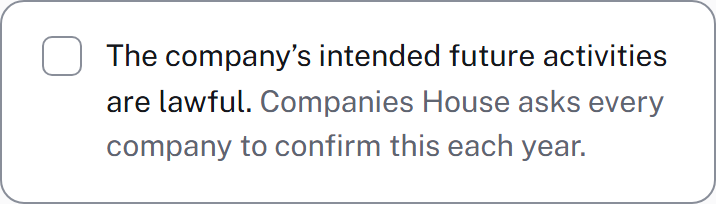
You confirm the company’s details on the register are correct: its registered office, directors, secretary, the address where it keeps its records, its people with significant control, its SIC code (what the company does), and, if it has shares, its statement of capital and shareholders4. You also state that the company’s intended future activities are lawful1. You confirm even if nothing has changed1.
Changes: before, or inside the statement
Some changes must be filed separately, before the confirmation statement: changes to the directors and secretary, the people with significant control, the registered office address and the registered email address1.
Others can be made inside the statement, in its additional information section: the SIC code, the statement of capital, the trading status of shares, an exemption from providing PSC information, and shareholder information1.
If the company hasn’t given Companies House a registered email address yet, the statement asks for one. It is not published on the register1.
Directors’ personal codes
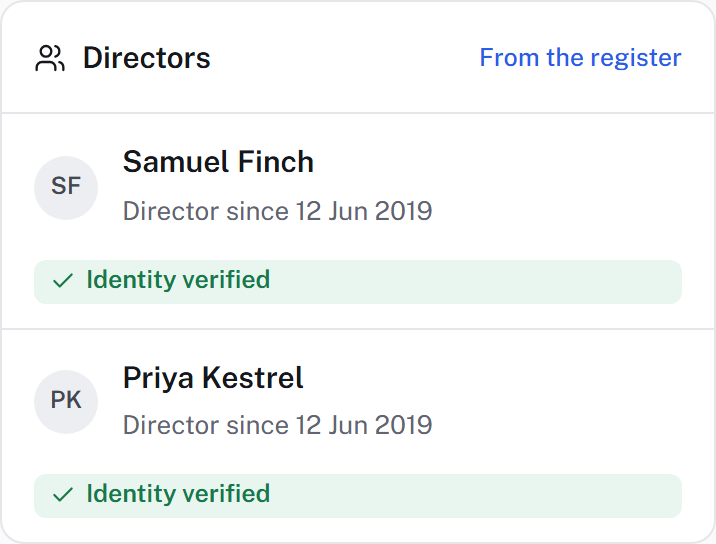
Since identity verification started, the statement asks for a Companies House personal code for each director, with a tick confirming each director has verified their identity. Companies House will not accept the statement until all the directors have verified1. Each director verifies once and uses the same code for every company5. People with significant control give their code separately, on their own timetable1.
If a director hasn’t verified yet, start now: see Companies House identity verification. If someone has lost their code, see where to find your personal code.
When it’s due
Your review period ends 12 months after the company was incorporated (for its first statement) or 12 months after the confirmation date on your last statement. You can file up to 14 days after it ends1.
A worked example
A company whose last confirmation date was 30 November 2025 reaches the end of its next review period on 30 November 2026. It can file any time up to 14 December 20261. You can find your company’s dates on the register, or in the deadline checker.
Filing early
You don’t have to wait. If you file early, you choose a new confirmation date, and your next review period starts the day after it1. File on 1 September 2026, say, choosing that day as the confirmation date, and the next statement is due by 15 September 2027.
What it costs
The fee is £50 online (including through software) and £110 for a paper form CS013. It is an annual fee, charged with the first statement you file in each 12-month payment period. The payment period is separate from the review period. It covers 12 months starting with the date of incorporation; for older companies, it ends each year on the anniversary of the return date of their last annual return (form AR01). You can’t change it1.
Paying the confirmation statement fee doesn’t stop a company being dormant for Companies House: the law lists it among the payments it ignores7.
How to file it
You file online with the company’s Companies House password and its authentication code. If you don’t have them, you register for online filing first2. The authentication code is posted to the registered office and can take up to 10 working days, so request it early if you need one6. Companies House can email you a reminder when your statement is due1.
Fileyear’s confirmation statement filing reads your company’s details from the register for you to check, asks for each director’s personal code, and files the statement, with Companies House’s fee shown in the price: £72.80 in total (£22.80 + the £50.00 Companies House fee).
If it’s late
If you don’t file, you can be fined up to £5,000, Companies House may issue a financial penalty, and the company may be struck off the register1. A company being restored to the register has to file a paper CS01, made up to the confirmation date that was due before it was struck off1.